Consultants connect
through Fullsight

Transparency & work-life balance - Fullsight has the environment where consultants are engaged and better connected.

Try it free
Fullsight's consultants features preview
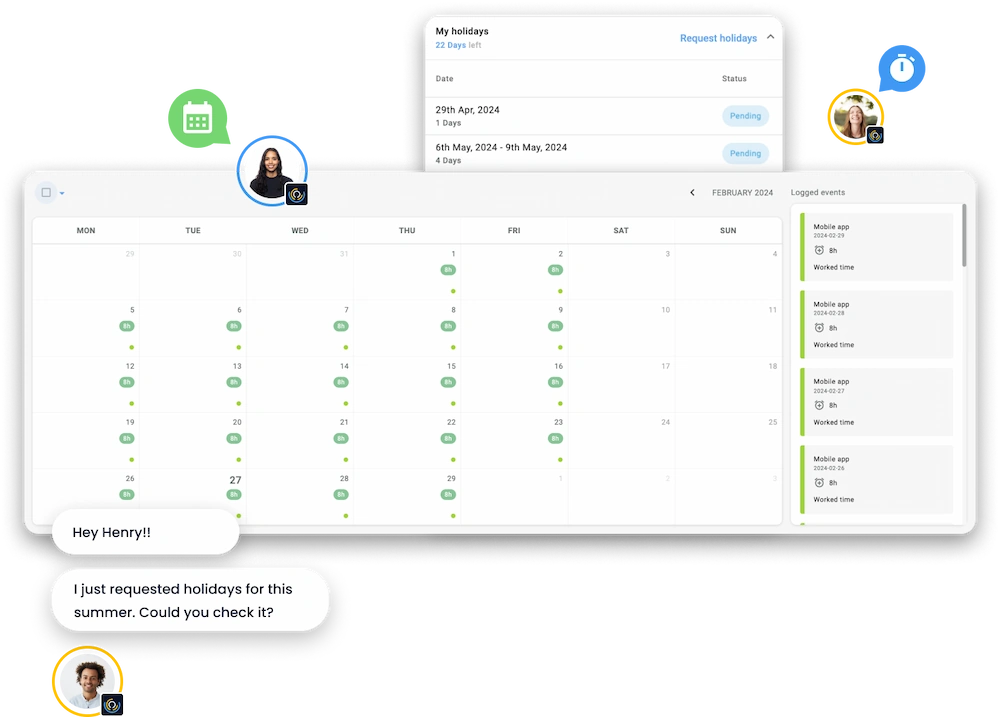
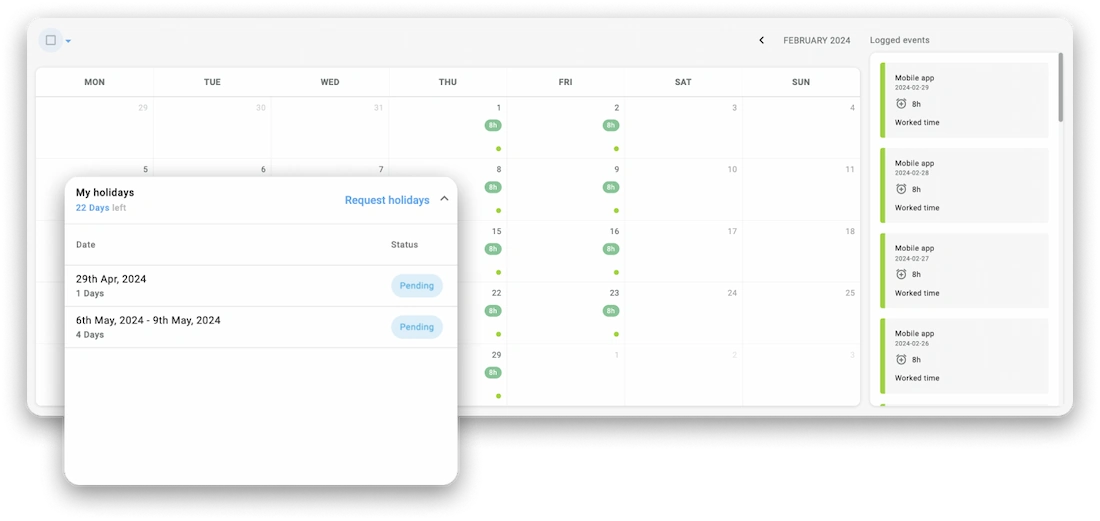
Preview of Fullsight's time and leave features

Simplify consultants'
time & leave management

Fullsight enhances time tracking and leave management for consultants, offering intuitive features for accurate time recording, and efficient holiday planning.

  • Track consultants worked time and ease customers' invoicing
  • Allow consultants to easily plan and request holidays
  • Manage consultants' leave days - no more spreadsheets
What makes an ATS truly effective for global teams

Community

What makes an ATS truly effective for global teams

Global hiring has become the norm for fast-growing companies, especially in technology, IT outsourcing and IT consulting. Teams are now distributed across countries, time zones and cultures, yet recruitment leaders are still expected to deliver speed, consistency and quality. In this context, an effective Applicant Tracking System becomes a critical business tool rather than just an HR solution. An ATS designed for global teams must go far beyond basic applicant management. Studies consistently show that companies using advanced recruitment technology can improve hiring efficiency by around 30 percent thanks to automation, better collaboration and improved data visibility. For international organizations, this efficiency only works when the Applicant Tracking System is flexible, intelligent and scalable.  Global compliance and localization One of the biggest challenges in global recruitment is regulatory compliance. Data protection laws, local labor regulations and privacy requirements vary significantly between regions. A truly effective ATS centralizes compliance while adapting to local hiring rules. Language localization, regional job boards and country-specific workflows are essential. Without these capabilities, global recruitment becomes slower, riskier and harder to manage.  AI recruitment that works across borders AI recruitment is no longer optional. A large majority of recruiters report that artificial intelligence helps them save time and improve candidate screening. For global teams, AI-powered Applicant Tracking System platforms ensure consistent evaluation of candidates regardless of location. Automated CV parsing, skills matching and ranking help recruiters focus on high-value interactions instead of repetitive tasks. In IT outsourcing and IT consulting, where technical expertise is in high demand, AI recruitment allows companies to process large volumes of applications without losing accuracy or fairness. An effective ATS uses AI to support decision-making while keeping humans firmly in control.  Integration with complex IT environments Global organizations depend on interconnected systems. An ATS must integrate seamlessly with HR platforms, payroll solutions and collaboration tools. In IT consulting environments, strong integrations reduce manual work and improve data reliability. For IT outsourcing companies managing high-volume recruitment, a connected Applicant Tracking System ensures smoother workflows and faster hiring cycles. When recruitment data flows easily across systems, organizations gain a clear and unified view of their global talent pipeline.  Recruitment analytics for strategic impact Data-driven recruitment is essential for global success. Metrics such as time to hire, cost per hire and quality of hire must be tracked consistently across regions. An effective ATS provides real-time dashboards and actionable insights that help teams identify bottlenecks and optimize processes.In AI recruitment, high-quality data is the foundation of performance. A global Applicant Tracking System standardizes recruitment data, enabling better workforce planning and stronger alignment between hiring and business strategy.  Consistent candidate experience worldwide Candidate experience plays a major role in employer branding. Research shows that more than half of candidates are more likely to accept a job offer after a positive recruitment experience. A global ATS must deliver clear communication, fast feedback and mobile-friendly applications across all regions. For IT consulting and IT outsourcing firms competing for scarce global talent, a strong candidate experience can be a decisive advantage.   Fullsight is an Applicant Tracking System built specifically for modern global teams. He combines AI recruitment, advanced analytics and seamless integration to support companies operating in IT consulting and IT outsourcing environments. Fullsight helps organizations centralize recruitment while respecting local needs, turning hiring into a scalable and strategic process. For companies looking to attract global talent and improve recruitment performance, Fullsight is an ATS designed to deliver results.

Read more
How to efficiently use Fullsight’s pipelines to improve hiring processes

Productivity

How to efficiently use Fullsight’s pipelines to improve hiring processes

Recruitment is one of the most critical aspects of business growth. Yet, many companies still struggle with slow, inefficient processes that frustrate both candidates and hiring managers. This is where an Applicant Tracking System (ATS) and advanced recruitment pipelines, like those offered by Fullsight, come into play. By structuring workflows and automating repetitive tasks, businesses can improve recruitment efficiency, enhance candidate experience, and support long-term productivity.  Why pipelines matter in recruitment Pipelines in an ATS allow HR management teams to visualize every step of the recruitment process, from the first application to final onboarding. Instead of relying on scattered emails and manual tracking, pipelines create a structured workflow that allows hiring managers to move candidates between stages with clarity and precision. Research indicates that 94% of recruiters report that using an ATS has enhanced their hiring process. With the right pipeline design, companies not only reduce time-to-hire but also strengthen collaboration between HR, management, and IT consulting teams.  Improving efficiency with Fullsight’s pipelines Fullsight’s pipelines are designed to make recruitment more transparent and effective. Each stage of the process - screening, interviews, technical assessments, and final decision - can be customized to fit business needs. This flexibility allows HR management teams to integrate IT outsourcing or IT consulting requirements directly into the pipeline, ensuring the right talent is matched to the right projects. Automation plays a key role. By setting automatic reminders, sending pre-built email templates, and tracking candidate progress in real time, Fullsight reduces the administrative workload of recruiters. This lets HR focus on meaningful interactions with candidates, which improves the overall candidate experience.  Business benefits beyond recruitment Efficient recruitment is more than just faster hiring. It impacts overall business performance. A structured pipeline helps companies avoid hiring delays that can stall projects, particularly in industries where IT outsourcing is essential. Better management of candidate flow also means fewer missed opportunities, improved employer branding, and higher employee retention.According to LinkedIn’s Global Talent Trends report, companies that offer a smooth candidate experience are 70% more likely to retain top talent. This underlines how tools like Fullsight’s ATS pipelines are not just about recruitment - they are a strategic asset for business management and growth.   By using Fullsight’s pipelines, businesses gain more than just recruitment software. They gain a partner that supports smarter HR management, improves efficiency across teams, and drives measurable business outcomes. If your company wants to optimize recruitment and benefit from structured, efficient pipelines, Fullsight is the solution to take your hiring process to the next level.

Read more
Beyond recruitment: how HR analytics drive overall business performance

Community

Beyond recruitment: how HR analytics drive overall business performance

Human resources is no longer just a support function. In 2026, HR analytics plays a central role in shaping overall business performance, going far beyond recruitment. With the rise of the Applicant Tracking System, AI recruitment and advanced data platforms, companies are turning people data into a strategic asset that directly impacts productivity, profitability and long-term growth. Organisations that make extensive use of HR analytics are significantly more likely to outperform competitors in productivity and financial results. This shift positions HR as a strategic driver, using data to support decisions that influence the entire business, not just hiring outcomes.  HR analytics as a business performance engine HR analytics connects workforce data with concrete business results. By analysing recruitment efficiency, employee performance, retention levels and skills gaps, leadership teams gain a clear understanding of how people-related decisions affect revenue, customer satisfaction and innovation capacity. A modern Applicant Tracking System plays a key role in this process. It collects structured recruitment data such as time to hire, quality of hire and candidate experience. When these insights are combined with AI recruitment capabilities, organisations can move from reactive hiring to predictive workforce planning, reducing costs and improving talent quality.  From recruitment data to strategic workforce planning HR analytics transforms recruitment information into long-term workforce strategy. By linking ATS data with performance and engagement metrics, companies can identify which profiles generate the highest business value over time. This insight is especially relevant in environments that rely on IT outsourcing and IT consulting, where the availability and performance of specialised talent directly impact project success. Data-driven workforce planning allows organisations to decide when to hire internally, when to rely on IT outsourcing and how to structure IT consulting teams more efficiently. HR analytics reduces uncertainty, supports smarter investment in skills and ensures alignment between talent strategy and business objectives.  AI recruitment and operational efficiency AI recruitment goes far beyond faster candidate screening. It improves operational efficiency across the organisation. By analysing historical recruitment data, performance trends and turnover patterns, AI models help predict hiring needs, reduce bias and improve role matching. When embedded within an Applicant Tracking System, AI recruitment tools automate repetitive tasks and free HR teams to focus on strategic initiatives. This enables HR to work more closely with finance and operations, using shared data insights to improve decision-making at every level.  HR analytics and leadership decision making Today, executives increasingly rely on HR analytics to guide high impact decisions. Workforce cost forecasting, productivity analysis and scenario modelling are becoming standard inputs in leadership discussions. HR data now influences expansion plans, digital transformation and service delivery models, particularly in IT consulting and IT outsourcing contexts. Despite this growing importance, many organisations still struggle to fully leverage HR analytics. Those who succeed gain a measurable competitive advantage by aligning people strategy with business performance goals.  Fullsight as the foundation of data-driven HR This is where Fullsight becomes essential. As a robust Applicant Tracking System, Fullsight enables organisations to capture, structure and analyse recruitment data with precision. He supports AI recruitment processes while integrating seamlessly into broader HR and business environments. By using Fullsight, companies gain more than an ATS. He becomes a strategic platform that connects recruitment, HR analytics and overall business performance. For organisations focused on smarter hiring, stronger IT consulting outcomes and more efficient IT outsourcing strategies, Fullsight provides the data-driven foundation needed to transform talent insights into sustained business results.

Read more
The rise of hybrid recruitment: balancing remote and in-person hiring

Community

The rise of hybrid recruitment: balancing remote and in-person hiring

In today’s rapidly evolving talent landscape, hybrid recruitment has emerged as a dominant model that effectively balances remote and in-person hiring. Companies across industries are redesigning their hiring strategy to attract top talent while adapting to new expectations around workplace flexibility. Hybrid recruitment isn’t just a buzz phrase — it’s reshaping how organizations find, screen and onboard candidates with help from powerful technology like Applicant Tracking System solutions and AI recruitment tools.  Remote work isn’t disappearing — but hybrid work is becoming the new norm. Recent data shows that more than half of remote-capable employees operate in a hybrid environment, while a similar share prefer this flexible arrangement. For recruiters, this means reevaluating traditional processes that were once anchored in on-site interviews and office presence. Hybrid recruitment blends virtual screening with selective in-person evaluation, giving companies access to broader talent pools and candidates a more work-life balance. Technology plays an essential role in this transformation. Applicant Tracking System platforms are now a cornerstone of efficient, hybrid hiring strategies. Statistics indicate that nearly all large organizations — including most Fortune 500 companies — rely on an ATS to manage candidate pipelines and workflows. ATS solutions help streamline recruitment, centralize applications, and automate administrative tasks that would otherwise slow hybrid recruiting initiatives. Artificial intelligence continues to drive innovation in recruitment technology. Around 79% of organizations have integrated AI into their ATS platforms to enhance candidate screening and ranking, helping recruiters focus on strategic decisions rather than manual filtering.  AI recruitment tools can reduce time-to-hire by automatically identifying qualified applicants and removing unqualified ones from the queue, improving efficiency and candidate experience alike.  Hybrid recruitment also aligns with broader trends in IT outsourcing and IT consulting. These sectors require rapid access to niche specialists, often on a global scale. Using hybrid recruiting models supported by advanced ATS and AI recruitment systems enables firms to source remote talent quickly while still conducting in-person assessments when needed to ensure cultural fit and project alignment. In the competitive world of IT projects, speed and precision matter.  The impact of hybrid recruitment isn’t limited to hiring speed. Companies with flexible work options see higher engagement and lower turnover, and job seekers increasingly prioritize hybrid roles when evaluating opportunities. Candidates frequently decline interviews or offers if flexibility is absent, highlighting the business advantage of hybrid hiring frameworks. In parallel, the Applicant Tracking System market is experiencing rapid growth, with its adoption driven by the need for scalable, cloud-based recruitment systems that support hybrid and remote hiring workflows.  Organizations are increasingly prioritizing advanced analytics, video interview integration, and mobile-friendly interfaces as they build hybrid recruiting ecosystems that serve both candidates and hiring teams. For companies focused on IT outsourcing and IT consulting priorities, the synergy between hybrid recruitment and recruitment technology cannot be overstated. An ATS is not just a workflow tool — it’s a strategic asset that reduces hiring cycle times, improves candidate quality, and enhances workforce planning. Platforms like Fullsight’s Applicant Tracking System combine AI recruitment capabilities with robust applicant management, helping firms stay competitive in hybrid hiring landscapes while maximizing efficiency and reach.  By embracing hybrid recruitment and leveraging modern ATS and AI recruitment technologies, businesses can attract qualified talent, streamline hiring operations, and remain agile in a talent market defined by flexibility and innovation.

Read more

Clarity in communication,
internal updates & job openings

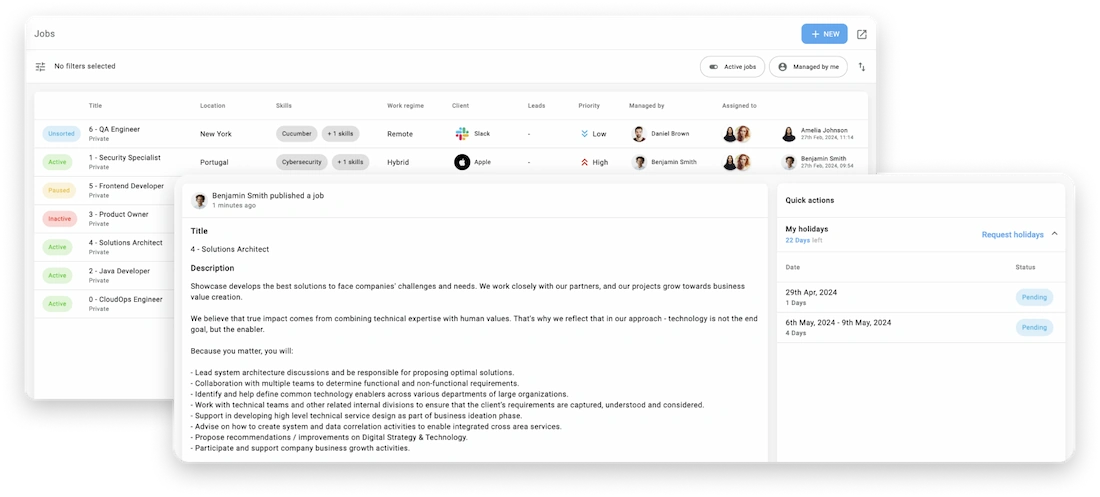
Fullsight boosts workplace transparency, providing a clear and consistent communication channel for internal updates and open job positions, ensuring consultants are always connected.

  • Share internal updates with everyone in the company
  • Have consultants informed about open job positions
  • Enable candidate recommendations from every employee
Fullsight's open vacancies and internal communication features

Integrations with your favorite apps with Fullsight

Greater speed, efficiency and productivity by integrating your tools with Fullsight

Slack icon
Microsoft teams icon
Gmail icon
Mailchimp icon
Outlook icon

Outsourcing firms count on Fullsight

Try it free

up to 3x

Faster recrutiment processes

up to 6x

Easier on onboardings

up to 4x

More visibility over operations

"Fullsight is an essential software for outsourcing companies, regardless of the size. Whether by improving recruitment processes or enhancing collaboration between recruitment and business teams, Fullsight simplifies operations and ensures visibility for greater success."

Bernardo Resende

Operations Manager - BySix, Portugal

Learn how Fullsight is surfing the wave

Take a deeper dive into how outsourcing firms work

What makes an ATS truly effective for global teams

Community

What makes an ATS truly effective for global teams

Global hiring has become the norm for fast-growing companies, especially in technology, IT outsourcing and IT consulting. Teams are now distributed across countries, time zones and cultures, yet recruitment leaders are still expected to deliver speed, consistency and quality. In this context, an effective Applicant Tracking System becomes a critical business tool rather than just an HR solution. An ATS designed for global teams must go far beyond basic applicant management. Studies consistently show that companies using advanced recruitment technology can improve hiring efficiency by around 30 percent thanks to automation, better collaboration and improved data visibility. For international organizations, this efficiency only works when the Applicant Tracking System is flexible, intelligent and scalable.  Global compliance and localization One of the biggest challenges in global recruitment is regulatory compliance. Data protection laws, local labor regulations and privacy requirements vary significantly between regions. A truly effective ATS centralizes compliance while adapting to local hiring rules. Language localization, regional job boards and country-specific workflows are essential. Without these capabilities, global recruitment becomes slower, riskier and harder to manage.  AI recruitment that works across borders AI recruitment is no longer optional. A large majority of recruiters report that artificial intelligence helps them save time and improve candidate screening. For global teams, AI-powered Applicant Tracking System platforms ensure consistent evaluation of candidates regardless of location. Automated CV parsing, skills matching and ranking help recruiters focus on high-value interactions instead of repetitive tasks. In IT outsourcing and IT consulting, where technical expertise is in high demand, AI recruitment allows companies to process large volumes of applications without losing accuracy or fairness. An effective ATS uses AI to support decision-making while keeping humans firmly in control.  Integration with complex IT environments Global organizations depend on interconnected systems. An ATS must integrate seamlessly with HR platforms, payroll solutions and collaboration tools. In IT consulting environments, strong integrations reduce manual work and improve data reliability. For IT outsourcing companies managing high-volume recruitment, a connected Applicant Tracking System ensures smoother workflows and faster hiring cycles. When recruitment data flows easily across systems, organizations gain a clear and unified view of their global talent pipeline.  Recruitment analytics for strategic impact Data-driven recruitment is essential for global success. Metrics such as time to hire, cost per hire and quality of hire must be tracked consistently across regions. An effective ATS provides real-time dashboards and actionable insights that help teams identify bottlenecks and optimize processes.In AI recruitment, high-quality data is the foundation of performance. A global Applicant Tracking System standardizes recruitment data, enabling better workforce planning and stronger alignment between hiring and business strategy.  Consistent candidate experience worldwide Candidate experience plays a major role in employer branding. Research shows that more than half of candidates are more likely to accept a job offer after a positive recruitment experience. A global ATS must deliver clear communication, fast feedback and mobile-friendly applications across all regions. For IT consulting and IT outsourcing firms competing for scarce global talent, a strong candidate experience can be a decisive advantage.   Fullsight is an Applicant Tracking System built specifically for modern global teams. He combines AI recruitment, advanced analytics and seamless integration to support companies operating in IT consulting and IT outsourcing environments. Fullsight helps organizations centralize recruitment while respecting local needs, turning hiring into a scalable and strategic process. For companies looking to attract global talent and improve recruitment performance, Fullsight is an ATS designed to deliver results.

Read more
How to efficiently use Fullsight’s pipelines to improve hiring processes

Productivity

How to efficiently use Fullsight’s pipelines to improve hiring processes

Recruitment is one of the most critical aspects of business growth. Yet, many companies still struggle with slow, inefficient processes that frustrate both candidates and hiring managers. This is where an Applicant Tracking System (ATS) and advanced recruitment pipelines, like those offered by Fullsight, come into play. By structuring workflows and automating repetitive tasks, businesses can improve recruitment efficiency, enhance candidate experience, and support long-term productivity.  Why pipelines matter in recruitment Pipelines in an ATS allow HR management teams to visualize every step of the recruitment process, from the first application to final onboarding. Instead of relying on scattered emails and manual tracking, pipelines create a structured workflow that allows hiring managers to move candidates between stages with clarity and precision. Research indicates that 94% of recruiters report that using an ATS has enhanced their hiring process. With the right pipeline design, companies not only reduce time-to-hire but also strengthen collaboration between HR, management, and IT consulting teams.  Improving efficiency with Fullsight’s pipelines Fullsight’s pipelines are designed to make recruitment more transparent and effective. Each stage of the process - screening, interviews, technical assessments, and final decision - can be customized to fit business needs. This flexibility allows HR management teams to integrate IT outsourcing or IT consulting requirements directly into the pipeline, ensuring the right talent is matched to the right projects. Automation plays a key role. By setting automatic reminders, sending pre-built email templates, and tracking candidate progress in real time, Fullsight reduces the administrative workload of recruiters. This lets HR focus on meaningful interactions with candidates, which improves the overall candidate experience.  Business benefits beyond recruitment Efficient recruitment is more than just faster hiring. It impacts overall business performance. A structured pipeline helps companies avoid hiring delays that can stall projects, particularly in industries where IT outsourcing is essential. Better management of candidate flow also means fewer missed opportunities, improved employer branding, and higher employee retention.According to LinkedIn’s Global Talent Trends report, companies that offer a smooth candidate experience are 70% more likely to retain top talent. This underlines how tools like Fullsight’s ATS pipelines are not just about recruitment - they are a strategic asset for business management and growth.   By using Fullsight’s pipelines, businesses gain more than just recruitment software. They gain a partner that supports smarter HR management, improves efficiency across teams, and drives measurable business outcomes. If your company wants to optimize recruitment and benefit from structured, efficient pipelines, Fullsight is the solution to take your hiring process to the next level.

Read more
Beyond recruitment: how HR analytics drive overall business performance

Community

Beyond recruitment: how HR analytics drive overall business performance

Human resources is no longer just a support function. In 2026, HR analytics plays a central role in shaping overall business performance, going far beyond recruitment. With the rise of the Applicant Tracking System, AI recruitment and advanced data platforms, companies are turning people data into a strategic asset that directly impacts productivity, profitability and long-term growth. Organisations that make extensive use of HR analytics are significantly more likely to outperform competitors in productivity and financial results. This shift positions HR as a strategic driver, using data to support decisions that influence the entire business, not just hiring outcomes.  HR analytics as a business performance engine HR analytics connects workforce data with concrete business results. By analysing recruitment efficiency, employee performance, retention levels and skills gaps, leadership teams gain a clear understanding of how people-related decisions affect revenue, customer satisfaction and innovation capacity. A modern Applicant Tracking System plays a key role in this process. It collects structured recruitment data such as time to hire, quality of hire and candidate experience. When these insights are combined with AI recruitment capabilities, organisations can move from reactive hiring to predictive workforce planning, reducing costs and improving talent quality.  From recruitment data to strategic workforce planning HR analytics transforms recruitment information into long-term workforce strategy. By linking ATS data with performance and engagement metrics, companies can identify which profiles generate the highest business value over time. This insight is especially relevant in environments that rely on IT outsourcing and IT consulting, where the availability and performance of specialised talent directly impact project success. Data-driven workforce planning allows organisations to decide when to hire internally, when to rely on IT outsourcing and how to structure IT consulting teams more efficiently. HR analytics reduces uncertainty, supports smarter investment in skills and ensures alignment between talent strategy and business objectives.  AI recruitment and operational efficiency AI recruitment goes far beyond faster candidate screening. It improves operational efficiency across the organisation. By analysing historical recruitment data, performance trends and turnover patterns, AI models help predict hiring needs, reduce bias and improve role matching. When embedded within an Applicant Tracking System, AI recruitment tools automate repetitive tasks and free HR teams to focus on strategic initiatives. This enables HR to work more closely with finance and operations, using shared data insights to improve decision-making at every level.  HR analytics and leadership decision making Today, executives increasingly rely on HR analytics to guide high impact decisions. Workforce cost forecasting, productivity analysis and scenario modelling are becoming standard inputs in leadership discussions. HR data now influences expansion plans, digital transformation and service delivery models, particularly in IT consulting and IT outsourcing contexts. Despite this growing importance, many organisations still struggle to fully leverage HR analytics. Those who succeed gain a measurable competitive advantage by aligning people strategy with business performance goals.  Fullsight as the foundation of data-driven HR This is where Fullsight becomes essential. As a robust Applicant Tracking System, Fullsight enables organisations to capture, structure and analyse recruitment data with precision. He supports AI recruitment processes while integrating seamlessly into broader HR and business environments. By using Fullsight, companies gain more than an ATS. He becomes a strategic platform that connects recruitment, HR analytics and overall business performance. For organisations focused on smarter hiring, stronger IT consulting outcomes and more efficient IT outsourcing strategies, Fullsight provides the data-driven foundation needed to transform talent insights into sustained business results.

Read more
The rise of hybrid recruitment: balancing remote and in-person hiring

Community

The rise of hybrid recruitment: balancing remote and in-person hiring

In today’s rapidly evolving talent landscape, hybrid recruitment has emerged as a dominant model that effectively balances remote and in-person hiring. Companies across industries are redesigning their hiring strategy to attract top talent while adapting to new expectations around workplace flexibility. Hybrid recruitment isn’t just a buzz phrase — it’s reshaping how organizations find, screen and onboard candidates with help from powerful technology like Applicant Tracking System solutions and AI recruitment tools.  Remote work isn’t disappearing — but hybrid work is becoming the new norm. Recent data shows that more than half of remote-capable employees operate in a hybrid environment, while a similar share prefer this flexible arrangement. For recruiters, this means reevaluating traditional processes that were once anchored in on-site interviews and office presence. Hybrid recruitment blends virtual screening with selective in-person evaluation, giving companies access to broader talent pools and candidates a more work-life balance. Technology plays an essential role in this transformation. Applicant Tracking System platforms are now a cornerstone of efficient, hybrid hiring strategies. Statistics indicate that nearly all large organizations — including most Fortune 500 companies — rely on an ATS to manage candidate pipelines and workflows. ATS solutions help streamline recruitment, centralize applications, and automate administrative tasks that would otherwise slow hybrid recruiting initiatives. Artificial intelligence continues to drive innovation in recruitment technology. Around 79% of organizations have integrated AI into their ATS platforms to enhance candidate screening and ranking, helping recruiters focus on strategic decisions rather than manual filtering.  AI recruitment tools can reduce time-to-hire by automatically identifying qualified applicants and removing unqualified ones from the queue, improving efficiency and candidate experience alike.  Hybrid recruitment also aligns with broader trends in IT outsourcing and IT consulting. These sectors require rapid access to niche specialists, often on a global scale. Using hybrid recruiting models supported by advanced ATS and AI recruitment systems enables firms to source remote talent quickly while still conducting in-person assessments when needed to ensure cultural fit and project alignment. In the competitive world of IT projects, speed and precision matter.  The impact of hybrid recruitment isn’t limited to hiring speed. Companies with flexible work options see higher engagement and lower turnover, and job seekers increasingly prioritize hybrid roles when evaluating opportunities. Candidates frequently decline interviews or offers if flexibility is absent, highlighting the business advantage of hybrid hiring frameworks. In parallel, the Applicant Tracking System market is experiencing rapid growth, with its adoption driven by the need for scalable, cloud-based recruitment systems that support hybrid and remote hiring workflows.  Organizations are increasingly prioritizing advanced analytics, video interview integration, and mobile-friendly interfaces as they build hybrid recruiting ecosystems that serve both candidates and hiring teams. For companies focused on IT outsourcing and IT consulting priorities, the synergy between hybrid recruitment and recruitment technology cannot be overstated. An ATS is not just a workflow tool — it’s a strategic asset that reduces hiring cycle times, improves candidate quality, and enhances workforce planning. Platforms like Fullsight’s Applicant Tracking System combine AI recruitment capabilities with robust applicant management, helping firms stay competitive in hybrid hiring landscapes while maximizing efficiency and reach.  By embracing hybrid recruitment and leveraging modern ATS and AI recruitment technologies, businesses can attract qualified talent, streamline hiring operations, and remain agile in a talent market defined by flexibility and innovation.

Read more
Loading...